Does the Universe have a Center of Gravity? Where is it?
Does the Universe have a Center of Gravity? Where is it?
Clumps of matter (visible and dark) in space, from the earth and moon to all the super galaxy clusters (at least two super super clusters), are observed(?) to be bound by forces (known and unknown) orbiting one another in their common center of the push and pull of these forces (dark energy and gravity). The orbit of objects within solar systems, specifically our own Milky Way, are mostly elliptical. By extension, we can assume the orbit between super super clusters to also be elliptical and super massive and the time to complete just one revolution is mind boggling by earthly standard measurements. Deep space proving of Hubble Space Telescope are discovering greater number of farther (older) galaxies with more to come. Is it too presumptuous to suggest that we have not had enough time to observe blue shifting galaxies orbiting towards us and that it is coincidental that all the red shifting galaxies observed are in their natural orbital journey away from us? Space time may eventually turn out to be expanding and the expansion is accelerating. However, do we know how much of the natural orbital motion of these observed galaxies contributes to the acceleration?
-
Chris Peterson

- Abominable Snowman
- Posts: 18412
- Joined: Wed Jan 31, 2007 11:13 pm
- Location: Guffey, Colorado, USA
- Contact:
Re: Does the Universe have a Center of Gravity? Where is it
Both theory and observation suggest that the Universe is unbounded and isotropic on a large scale. Therefore, there is no center of gravity. Regions causally connected to others interact via gravity or other mechanisms, of course. But those should be seen as local interactions (even though "local" may encompass a very large volume).ErnieM wrote:Clumps of matter (visible and dark) in space, from the earth and moon to all the super galaxy clusters (at least two super super clusters), are observed(?) to be bound by forces (known and unknown) orbiting one another in their common center of the push and pull of these forces (dark energy and gravity). The orbit of objects within solar systems, specifically our own Milky Way, are mostly elliptical. By extension, we can assume the orbit between super super clusters to also be elliptical and super massive and the time to complete just one revolution is mind boggling by earthly standard measurements. Deep space proving of Hubble Space Telescope are discovering greater number of farther (older) galaxies with more to come. Is it too presumptuous to suggest that we have not had enough time to observe blue shifting galaxies orbiting towards us and that it is coincidental that all the red shifting galaxies observed are in their natural orbital journey away from us? Space time may eventually turn out to be expanding and the expansion is accelerating. However, do we know how much of the natural orbital motion of these observed galaxies contributes to the acceleration?
Chris
*****************************************
Chris L Peterson
Cloudbait Observatory
https://www.cloudbait.com
*****************************************
Chris L Peterson
Cloudbait Observatory
https://www.cloudbait.com
Re: Does the Universe have a Center of Gravity? Where is it
Chris Peterson wrote
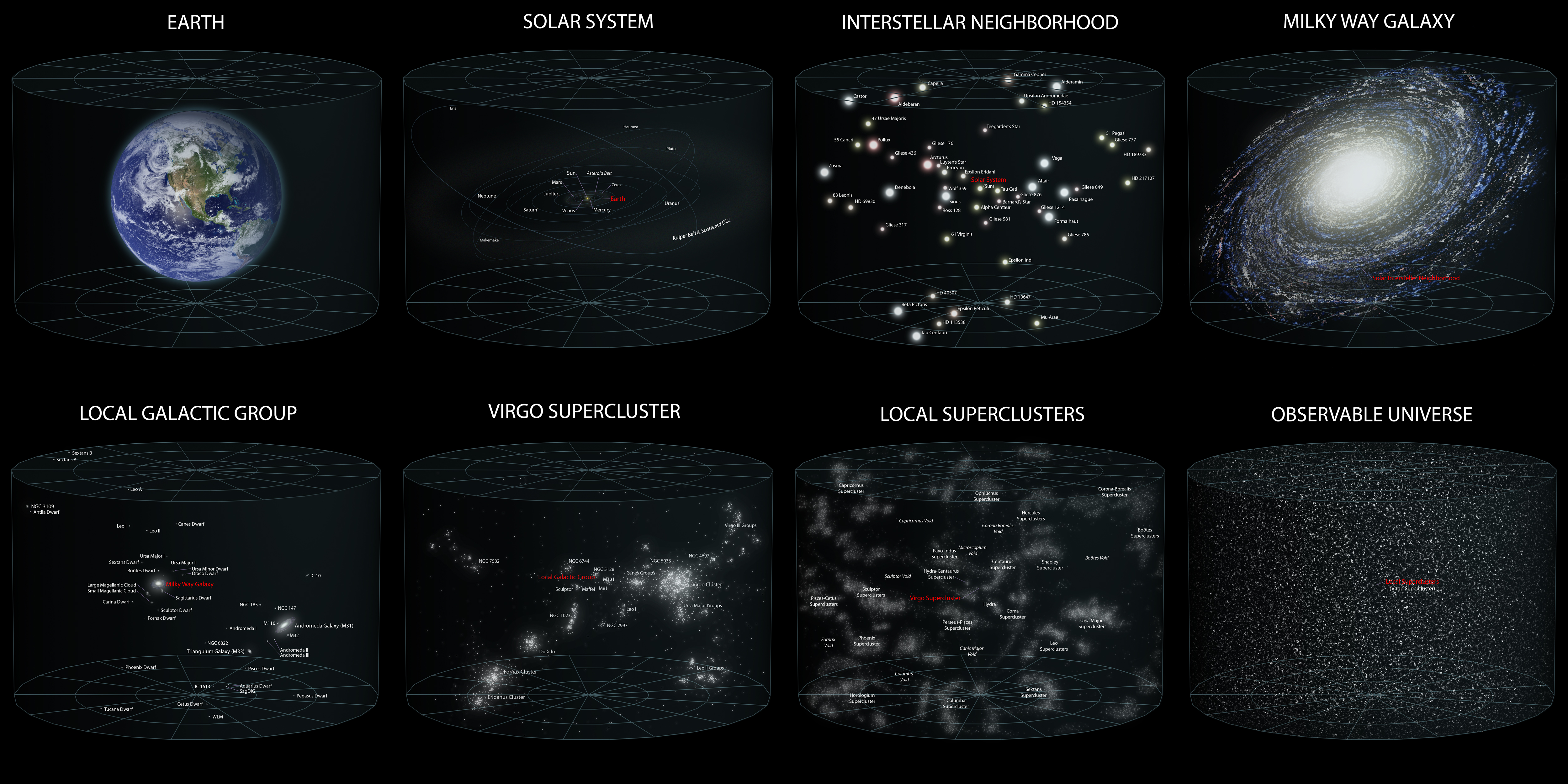
This is a link from wikipedia depicting the earth's location in the "observable" universe based on the grouping or clustering of matter. Surely, there must be some force or energy form(s) that keeps these clusters of matter together and thus preventing them from flying out in every direction.
http://upload.wikimedia.org/wikipedia/c ... PEG%29.jpgBoth theory and observation suggest that the Universe is unbounded and isotropic on a large scale. Therefore, there is no center of gravity. Regions causally connected to others interact via gravity or other mechanisms, of course. But those should be seen as local interactions (even though "local" may encompass a very large volume).
This is a link from wikipedia depicting the earth's location in the "observable" universe based on the grouping or clustering of matter. Surely, there must be some force or energy form(s) that keeps these clusters of matter together and thus preventing them from flying out in every direction.
-
Chris Peterson
- Abominable Snowman
- Posts: 18412
- Joined: Wed Jan 31, 2007 11:13 pm
- Location: Guffey, Colorado, USA
- Contact:
Re: Does the Universe have a Center of Gravity? Where is it
Gravity.ErnieM wrote:This is a link from wikipedia depicting the earth's location in the "observable" universe based on the grouping or clustering of matter. Surely, there must be some force or energy form(s) that keeps these clusters of matter together and thus preventing them from flying out in every direction.
Chris
*****************************************
Chris L Peterson
Cloudbait Observatory
https://www.cloudbait.com
*****************************************
Chris L Peterson
Cloudbait Observatory
https://www.cloudbait.com
Re: Does the Universe have a Center of Gravity? Where is it
Then I am back to the original question, where is the center of gravity of the visible universe?
-
Chris Peterson
- Abominable Snowman
- Posts: 18412
- Joined: Wed Jan 31, 2007 11:13 pm
- Location: Guffey, Colorado, USA
- Contact:
Re: Does the Universe have a Center of Gravity? Where is it
Of the observable Universe? That would be approximately where you are standing.ErnieM wrote:Then I am back to the original question, where is the center of gravity of the visible universe?
Chris
*****************************************
Chris L Peterson
Cloudbait Observatory
https://www.cloudbait.com
*****************************************
Chris L Peterson
Cloudbait Observatory
https://www.cloudbait.com
-
neufer

- Vacationer at Tralfamadore
- Posts: 18805
- Joined: Mon Jan 21, 2008 1:57 pm
- Location: Alexandria, Virginia
Re: Does the Universe have a Center of Gravity? Where is it
I've always had my suspicions that that was so.Chris Peterson wrote:Of the observable Universe? That would be approximately where you are standing.ErnieM wrote:
Then I am back to the original question, where is the center of gravity of the visible universe?
Art Neuendorffer
Re: Does the Universe have a Center of Gravity? Where is it
Hey, ErnieM. Just like waht you say, it's surely that there must be some force or energy form(s) that keeps these clusters of matter together and thus preventing them from flying out in every direction.
But what is it? Will it something like black hole, while its force is not so strong like black. I think you know my meaning.
But what is it? Will it something like black hole, while its force is not so strong like black. I think you know my meaning.

Re: Does the Universe have a Center of Gravity? Where is it
ErnieM asked:

Me too!
Ann
Chris Peterson replied:Then I am back to the original question, where is the center of gravity of the visible universe?
neufer commented:Of the observable Universe? That would be approximately where you are standing.
I've always had my suspicions that that was so.
Me too!
Ann
Color Commentator

Re: Does the Universe have a Center of Gravity? Where is it
Thank you all for very enlightening replies. Kind of make sense (for now) , specially with this view of the "observed" universe within 1 billion light years from earth.
http://www.atlasoftheuniverse.com/superc.html
Our Milky Way is in the Virgo cluster. I wonder how the view would appear on telescopes located at the planet in the Corona-Borealis super cluster. Future generations of telescopes and instruments may yet provide astronomers with a much better answer.
http://www.atlasoftheuniverse.com/superc.html
Our Milky Way is in the Virgo cluster. I wonder how the view would appear on telescopes located at the planet in the Corona-Borealis super cluster. Future generations of telescopes and instruments may yet provide astronomers with a much better answer.
Re: Does the Universe have a Center of Gravity? Where is it
Gravity itself does not have a specific location; it is present everywhere. Therefore, there is no such thing as an absolute "Center of Gravity" for the universe, just as there is no such thing as the center of the surface of a sphere. Since all matter in the universe exerts an equal and opposite attraction to all other matter in the universe, the term "center of gravity" is only helpful when one wants to measure or speak about the effects of gravity between certain specified objects.
-
Chris Peterson
- Abominable Snowman
- Posts: 18412
- Joined: Wed Jan 31, 2007 11:13 pm
- Location: Guffey, Colorado, USA
- Contact:
Re: Does the Universe have a Center of Gravity? Where is it
The question of whether there is a center of gravity of the Universe does not depend on the nature of gravity, but on the nature of the Universe. But certainly, any bounded area of the Universe (such as the observable universe) has a true center of gravity, which will be fairly close to, but not exactly at, the observer's position.charlieo3 wrote:Gravity itself does not have a specific location; it is present everywhere. Therefore, there is no such thing as an absolute "Center of Gravity" for the universe, just as there is no such thing as the center of the surface of a sphere. Since all matter in the universe exerts an equal and opposite attraction to all other matter in the universe, the term "center of gravity" is only helpful when one wants to measure or speak about the effects of gravity between certain specified objects.
Chris
*****************************************
Chris L Peterson
Cloudbait Observatory
https://www.cloudbait.com
*****************************************
Chris L Peterson
Cloudbait Observatory
https://www.cloudbait.com
Re: Does the Universe have a Center of Gravity? Where is it
Suppose there are two observers, say one in New York City and one in San Francisco. Will the center of gravity of the universe be the same or different for the two observers?
-
Chris Peterson
- Abominable Snowman
- Posts: 18412
- Joined: Wed Jan 31, 2007 11:13 pm
- Location: Guffey, Colorado, USA
- Contact:
Re: Does the Universe have a Center of Gravity? Where is it
That depends on the nature of the Universe, which isn't known. Probably, though. But each of those observers is at the center of his own observable universe, and certainly the center of gravity of each will be in different locations, both in absolute terms and relative to the two observers.charlieo3 wrote:Suppose there are two observers, say one in New York City and one in San Francisco. Will the center of gravity of the universe be the same or different for the two observers?
Chris
*****************************************
Chris L Peterson
Cloudbait Observatory
https://www.cloudbait.com
*****************************************
Chris L Peterson
Cloudbait Observatory
https://www.cloudbait.com
-
neufer
- Vacationer at Tralfamadore
- Posts: 18805
- Joined: Mon Jan 21, 2008 1:57 pm
- Location: Alexandria, Virginia
Re: Does the Universe have a Center of Gravity? Where is it
.
"The fabric of the world will have its center everywhere and circumference nowhere."
- Cardinal Nicholas of Cusa in his Learned Ignorance asked whether there was any reason
to assert that the Sun (or any other point) was the center of the universe.
- Cardinal Nicholas of Cusa in his Learned Ignorance asked whether there was any reason
to assert that the Sun (or any other point) was the center of the universe.
http://www.lpod.org/?p=1120 wrote:<<When I need an image for LPOD (every night!) I can always find an intriguing one at Damian Peach’s website, which may be the largest collection of high quality lunar images by any single observer. This one caught my eye for three reasons - I couldn’t identify the craters, the feature on the right is bizarre, and the entire scene is very dramatic! 73 km-wide Petermann is the flat-floored crater on the left, and 63 km-wide Cusanus is to the right; both are near the Moon’s northeast limb, between Mare Humboldtianum and the pole. The lighting in Damian’s image shows the arc-ed shadow cast by the west rim of Cusanus, but the east rim looks like a series of pointy mountains. Clamoring to find a vertical view of these craters I discovered that there is no good one from Lunar Orbiters but Clementine (below) provides an explanation. The east wall of Cusanus is cut by two or three later small craters whose western rims are low or missing. So in Damian’s image we are looking at cross-sections of impact craters. What a remarkable view!>> - Chuck Wood


http://en.wikipedia.org/wiki/Nicholas_of_Cusa wrote:
Nicholas of Kues (1401 – August 11, 1464), also referred to as Nicolaus Cusanus and Nicholas of Cusa, was a cardinal of the Catholic Church from Germany (Holy Roman Empire), a philosopher, theologian, jurist, mathematician, and an astronomer. He is widely considered one of the great geniuses and polymaths of the 15th century. He is today recognized for significant spiritual, scientific and political contributions in European history, notable examples of which include his mystical or spiritual writings on 'learned ignorance' (and mathematical ideas expressed in related essays), as well as his participation in power struggles between Rome and the German states of the Holy Roman Empire.
Nicholas of Cusa or Kues (Latinized as "Cusa") was the second of four children of Johan Krebs (or Cryfftz) and Katherina Roemer. His father was "a prosperous boat owner and ferryman." He entered the University of Heidelberg in 1416 as "a cleric of the diocese of Trier" studying the liberal arts. He then received his doctorate in Canon law from the University of Padua in 1423. Afterwards, he entered the University of Cologne in 1425 as "a doctor of canon law" which it appears he both taught and practiced there. After a successful career as a papal envoy, he was made a theologian by Pope Nicholas V in 1448 or 1449, and was named Bishop of Brixen in 1450.
Nicholas of Cusa was noted for his deeply mystical writings about Christianity, particularly on the possibility of knowing God with the divine human mind — not possible through mere human means — via "learned ignorance". He was suspected by some of holding pantheistic beliefs. Nicholas also wrote in De coniecturis about using conjectures or surmises to rise to better understanding of the truth. The individual might rise above mere reason to the vision of the intellect, but the same person might fall back from such vision.
Nicholas is also considered by many to be a genius ahead of his time in the field of science. Nicolaus Copernicus, Galileo Galilei and Giordano Bruno were all aware of the writings of Cusanus as was Johannes Kepler (who called Cusanus 'divinely inspired' in the first paragraph of his first published work). Predating Kepler, Cusanus said that no perfect circle can exist in the universe (opposing the Aristotelean model, and also Copernicus' later assumption of circular orbits), thus opening the possibility for Kepler's model featuring elliptical orbits of the planets around the Sun. He also influenced Giordano Bruno by denying the finiteness of the universe and the Earth's exceptional position in it (being not the center of the universe, and in that regard equal in rank with the other stars). He was not, however, describing a scientifically verifiable theory of the universe: his beliefs (which proved uncannily accurate) were based almost entirely on his own personal numerological calculations and metaphysics.
Cusanus made important contributions to the field of mathematics by developing the concepts of the infinitesimal and of relative motion. He was the first to use concave lenses to correct myopia. His writings were essential for Leibniz's discovery of calculus as well as Cantor's later work on infinity. Most of his mathematical ideas can be found in his essays, De Docta Ignorantia (Of Learned Ignorance), De Visione Dei (On the Vision of God) and On Conjectures. He also wrote on squaring the circle in his mathematical treatises.>>
Art Neuendorffer
Re: Does the Universe have a Center of Gravity? Where is it
I like this guy, Nicholaus Cusanus, and I like the quote. I think, however, that I am glad I did not live in the 15th Century with him. I'll take the age we live in, thank you. 
Re: Does the Universe have a Center of Gravity? Where is it
I'll say.charlieo3 wrote:I like this guy, Nicholaus Cusanus, and I like the quote. I think, however, that I am glad I did not live in the 15th Century with him. I'll take the age we live in, thank you.

This is a portrait of a Swedish family who lived in the 18th century. As you can see, they had a lot of children. The parents and many of their children look very happy, but several of the children are partly hidden behind their siblings. One son, the oldest, has turned his face away, looking at books in a bookcase. One little baby, who isn't hidden, has her eyes closed, looking sad.
Why are these children partly hidden? It's because they are dead. The husband and wife had had fifteen children, but when this portrait was painted, seven of the fifteen children had died.
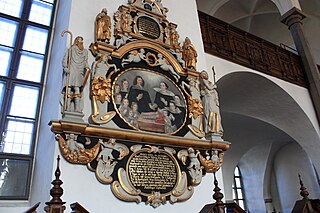
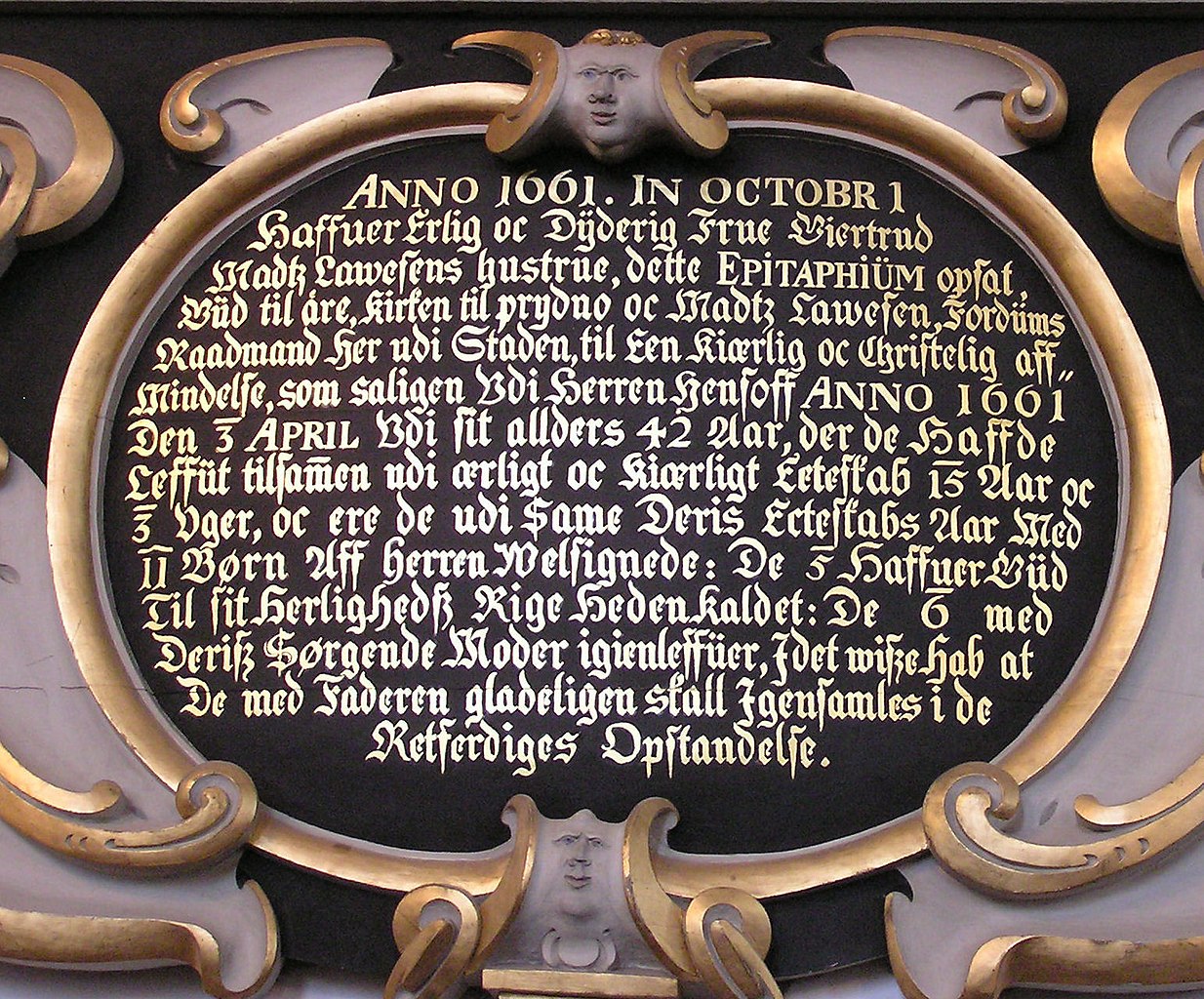
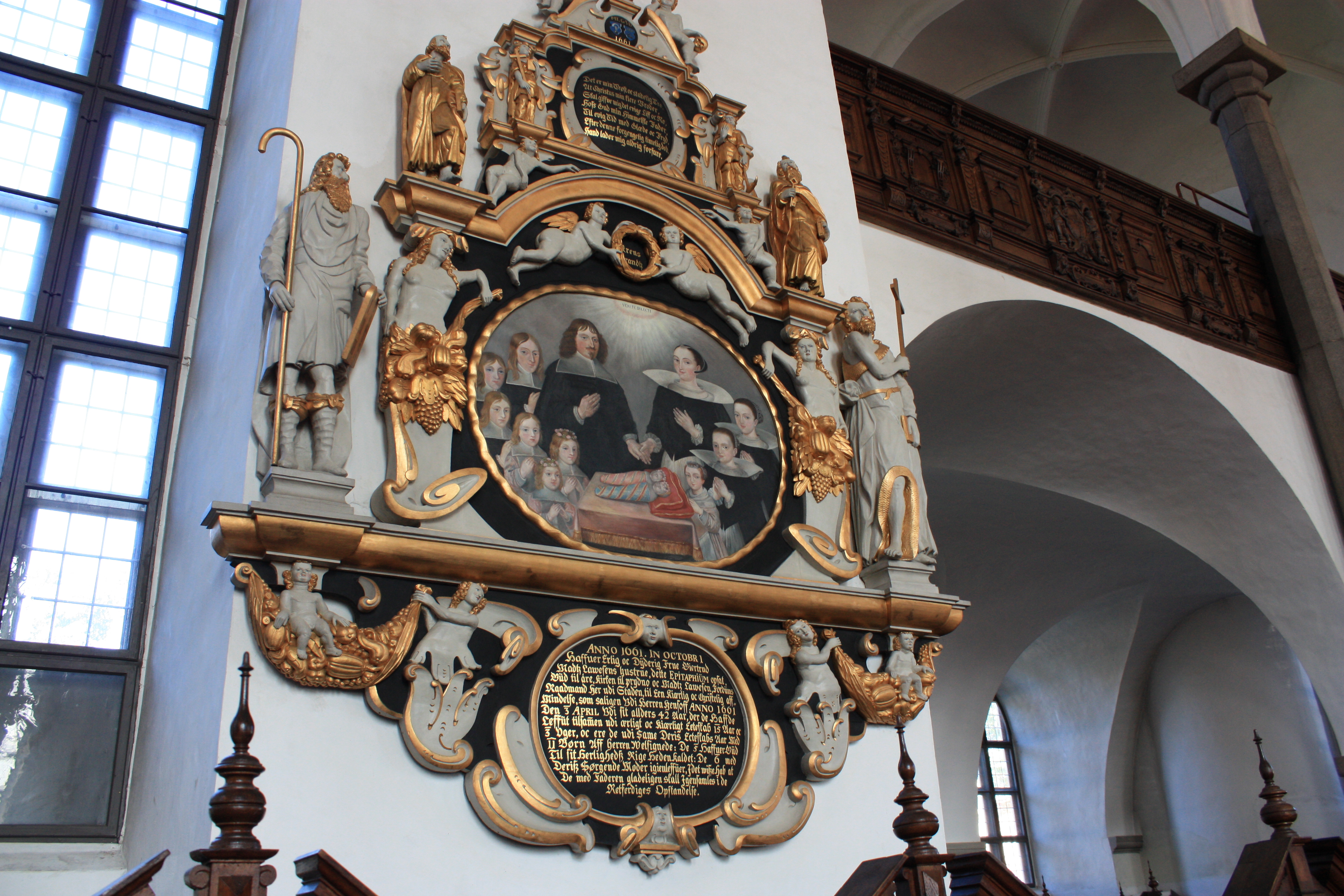
This is my favorite epitaphium, a family portrait of living and dead members, in a church. The epitaphium can be found in Heliga Trefaldighetskyrkan in Kristianstad. You can look at the epitaphium at full resolution here. I can't read the text under the painting very well, because the lettering is horrible (I think), and the language is some sort of 17th century Danish-Swedish. But it does say that the epitaphium was put up by the "loving and virtuous" wife of the deceased, that the husband was 42 years old when he died, that he and his wife had been married for "fifteen years and three days" when he died, and that the couple had had eleven children in those fifteen years, and that five of the eleven children had been "brought to the Kingdom of Heaven" when this painting was made. You can tell the dead children from the living one in that the dead children are wearing crowns. Note how the oldest of the dead girls, a girl of perhaps five years old, is sort of "taking care" of her two dead baby siblings so that they won't get lost in the Kingdom of Heaven!

Here's my point. One of the sisters had 22 children. Can you imagine? Amazingly, not a single of her children died when they were small babies. Later, however, they were mowed down with horrific efficacy by the Grim Reaper. When I read the book I didn't quite get how many of her children actually died before they had become adults, but my definite impression was that most of them died. Perhaps eight of them lived to be adults. Out of 22.
I have often wondered what it must have been like to be a child back then and see so many of your siblings die. Presumably, a lot of children that you knew, even if they were not your siblings, also died when you yourself was a child. Today many of us take life pretty much for granted. Back then, you must have wondered, even as a child, if you weren't going to die soon. Or at least it seems like that to me.
The quote is from Shalespeare's MacBeth. The point seems to be that it is absolutely extraordinary to have lived long enough to remember seventy years.Threescore and ten I can remember well:
Within the volume of which time I have seen
Hours dreadful and things strange; but this sore night
Hath trifled former knowings.
But to return to Nicholaus Cusanus: I, too, am impressed by him.
Ann
Last edited by Ann on Sun Oct 16, 2011 5:37 am, edited 2 times in total.
Color Commentator
-
rstevenson

- Quis custodiet ipsos custodes?
- Posts: 2705
- Joined: Fri Mar 28, 2008 1:24 pm
- Location: Halifax, NS, Canada
Re: Does the Universe have a Center of Gravity? Where is it
The Lennox Sisters have their own page on Wikipedia, so forward thinking were they. From it I learned that there were 5 sisters who lived to adulthood, 3 who died in childhood and 1 who lived to age 19, 2 brothers who lived to adulthood and 2 who died young. Between the five sisters, they had a total of 31 children of whom at least 14 and perhaps 9 others lived past childhood.
Rob
Rob
Re: Does the Universe have a Center of Gravity? Where is it
http://en.wikipedia.org/wiki/Lennox_Sisters wrote:
But I was wrong that a majority of Emily's children died during childhood. Undoubtedly Wikipedia is right that twelve of Emily's children by her first husband survived until adulthood. However, surviving until adulthood doesn't mean that some of these "survivors of childhood" might not still have died young. Since Stelly Tillyard's book is based on the correspondence between her and her sisters, it might be that Emily, who lived past the age of eighty, wrote to her sisters about the death in early adulthood of some of her children.
The world-famous painter Rembrandt (Rembrandt Harmenszoon van Rijn) saw all of his children die, with the possible exception of an out-of-wedlock daughter. http://en.wikipedia.org/wiki/Rembrandt wrote:
Horror. No wonder Rembrandt painted so many moving works, full of pain.
Ann
I'm sure Stella Tillyard claimed that Emily had 22 children altogether. There seems to be disagreement over how many children Emily had with her first husband.Amelia Mary Lennox was born on 6 October 1731 and died on 27 March 1814.[1] On 7 February 1747 she married James Fitzgerald, 20th Earl of Kildare and 1st Duke of Leinster, becoming Emily Fitzgerald, Duchess of Leinster. The couple had at least sixteen children, twelve of whom survived to adulthood. In 1774, a year after her husband died in 1773, Emily outraged society in Ireland by marrying her children's tutor, William Ogilvie, in France. With Ogilvie she had four more children.
But I was wrong that a majority of Emily's children died during childhood. Undoubtedly Wikipedia is right that twelve of Emily's children by her first husband survived until adulthood. However, surviving until adulthood doesn't mean that some of these "survivors of childhood" might not still have died young. Since Stelly Tillyard's book is based on the correspondence between her and her sisters, it might be that Emily, who lived past the age of eighty, wrote to her sisters about the death in early adulthood of some of her children.
The world-famous painter Rembrandt (Rembrandt Harmenszoon van Rijn) saw all of his children die, with the possible exception of an out-of-wedlock daughter. http://en.wikipedia.org/wiki/Rembrandt wrote:
Although they [Rembrandt and his wife Saskia] were by now affluent, the couple suffered several personal setbacks; their son Rumbartus died two months after his birth in 1635 and their daughter Cornelia died at just three weeks of age in 1638. In 1640, they had a second daughter, also named Cornelia, who died after living barely over a month. Only their fourth child, Titus, who was born in 1641, survived into adulthood. Saskia died in 1642 soon after Titus's birth, probably from tuberculosis. Rembrandt's drawings of her on her sick and death bed are among his most moving works.
In the late 1640s Rembrandt began a relationship with the much younger Hendrickje Stoffels, who had initially been his maid. In 1654 they had a daughter, Cornelia, bringing Hendrickje a summons from the Reformed Church to answer the charge "that she had committed the acts of a whore with Rembrandt the painter". She admitted this and was banned from receiving communion. Rembrandt was not summoned to appear for the Church council because he was not a member of the Reformed Church. The two were considered legally wed under common law, but Rembrandt had not married Henrickje, so as not to lose access to a trust set up for Titus in the son's mother's will.
Titus, Rembrandt's only surviving son, painted by his father. Titus died at 29.
Titus was very important to his father. But Titus died young, too:
Rembrandt outlived both Hendrickje, who died in 1663, and Titus, who died in 1668, leaving a baby daughter. He died within a year of his son, on October 4, 1669 in Amsterdam, and was buried in an unmarked grave in the Westerkerk.
Horror. No wonder Rembrandt painted so many moving works, full of pain.
Ann
Color Commentator
-
rstevenson
- Quis custodiet ipsos custodes?
- Posts: 2705
- Joined: Fri Mar 28, 2008 1:24 pm
- Location: Halifax, NS, Canada
Re: Does the Universe have a Center of Gravity? Where is it
I suspect most families would have, from only a generation or two past, similar tales to tell. On the whole, I can think of no earlier time I would be happy to live in. I need only think of dental care or any other medical care to reach that conclusion. (I doubt I would have survived past the age of 6, or perhaps 3, without "modern" (1950s) medical care. My mother kept a list of the dates and illnesses we all had, and it's frightening to read it now.)
Rob
Rob
Re: Does the Universe have a Center of Gravity? Where is it
Sorry, but as a calligrapher I just cannot let that comment go by. Please do not confuse letter shapes in both a script and a language you are not familiar with as "horrible" lettering. This is a marvelous example of fine calligraphy (which means "beautiful writing"), made all the more remarkable by the fact that it is done in gold leaf.the lettering is horrible (I think), and the language is some sort of 17th century Danish-Swedish.
Here is an image from a better angle and slightly sharper focus.
Last edited by owlice on Tue Oct 25, 2011 1:16 am, edited 1 time in total.
Reason: Changed img tag to img2 tag; thanks (from one who handwrote her wedding invitations in Copperplate) for sharing!
Reason: Changed img tag to img2 tag; thanks (from one who handwrote her wedding invitations in Copperplate) for sharing!


Re: Does the Universe have a Center of Gravity? Where is it
Hey, look about in the middle of the calligraphy. It looks like they discovered the answer to Everything -42- way back then. Must have been one-heck-of-a-big abacus they had back then.charlieo3 wrote:Sorry, but as a calligrapher I just cannot let that comment go by. Please do not confuse letter shapes in both a script and a language you are not familiar with as "horrible" lettering. This is a marvelous example of fine calligraphy (which means "beautiful writing"), made all the more remarkable by the fact that it is done in gold leaf.the lettering is horrible (I think), and the language is some sort of 17th century Danish-Swedish.
Here is an image from a better angle and slightly sharper focus.

To find the Truth, you must go Beyond.
-
geckzilla

- Ocular Digitator
- Posts: 9180
- Joined: Wed Sep 12, 2007 12:42 pm
- Location: Modesto, CA
- Contact:
Re: Does the Universe have a Center of Gravity? Where is it
It is very difficult for a modern person to appreciate hand written typefaces without studying typography or calligraphy first. In college I had to design and hand paint a poster full of typography and it was definitely an undertaking I wouldn't want to repeat. That one sign probably has 10 times the letters I had. It's an exquisite work of art. I want to say it's even more expertly crafted than the painting above or the surrounding sculpture, but I'm not actually that well versed in classical typography.
Just call me "geck" because "zilla" is like a last name.
Re: Does the Universe have a Center of Gravity? Where is it
I absolutely understand what you mean, charlieo3. It's just that this beautiful lettering makes the words horribly difficult for me to read!!!
Ann
Ann
Color Commentator