Besides "Layher" (the scaffolding maker) being correct in two places, there is a bit of other text scattered around, which is also correct. The image is certainly not mirrored.ChrisP wrote:I don't believe it is. If it were, the letters in the scaffolding would be reversed (mirrored). As it is, they're simply upside-down on the larger one in the lower left. But that's likely just the way it was assembled. The smaller scaffold in the center of the far right side is correct, suggesting the image is correctly oriented.
APOD: Hints of Higgs from the Large Hadron... (2011 Dec 18)
-
Chris Peterson

- Abominable Snowman
- Posts: 18185
- Joined: Wed Jan 31, 2007 11:13 pm
- Location: Guffey, Colorado, USA
- Contact:
Re: APOD: Hints of Higgs from the Large Hadron... (2011 Dec
Chris
*****************************************
Chris L Peterson
Cloudbait Observatory
https://www.cloudbait.com
*****************************************
Chris L Peterson
Cloudbait Observatory
https://www.cloudbait.com
-
Chris Peterson
- Abominable Snowman
- Posts: 18185
- Joined: Wed Jan 31, 2007 11:13 pm
- Location: Guffey, Colorado, USA
- Contact:
Re: APOD: Hints of Higgs from the Large Hadron... (2011 Dec
guest23 wrote:Look at 7:45 position, just outside and beyond the big sensor wheel at back center: two faces, next to each other, one in front removing helmet, the other bare headed. They look Indian.
- atlas_cern_3008_clip.jpg (33.64 KiB) Viewed 2346 times
Chris
*****************************************
Chris L Peterson
Cloudbait Observatory
https://www.cloudbait.com
*****************************************
Chris L Peterson
Cloudbait Observatory
https://www.cloudbait.com

-
neptunium
Re: APOD: Hints of Higgs from the Large Hadron... (2011 Dec
Not in there!Winky-Flink wrote:Gee wiz, neptunium. There's at least a kabillion universes in parallel with ours, all 3 1/2 years out of synch with each other and us.
Winky-Flink wrote:Not to mention the ones that are 2 minutes apart or 17 microns apart or 183,622 orders of magnitude larger or smaller, ad infinitum.
Obviously you don't understand what I said. I was talking about the "universe" that Sandstone was pointing out.
I understand that. Wouldn't there have been, though, something different seen in that "universe"?Winky-Flink wrote:Of course they have something different to be 'seen' in them but they have lots of things the same, too.
Winky-Flink wrote:You don't get around much.

Sometimes I watch too much, thank you very much.Winky-Flink wrote:Watch more TV.

-
Farinada
Re: APOD: Hints of Higgs from the Large Hadron... (2011 Dec
Chris Peterson wrote:There is no danger. None at all, and the "knowledgeable people" who are concerned are being foolish.nstahl wrote:Ok I acknowledge finding Higgs, and the details about Higgs, is a Very Big Deal. But dammit they also want to make black holes with that, and while they say they're sure those black holes will then quickly evaporate there's a really, really big downside if they are wrong.
First of all, so what if they create black holes that don't evaporate? They are still just subatomic particles with incredibly tiny masses. They aren't going to absorb other mass, because their event horizons are so small they virtually never intersect with other matter. You need something like hundreds of times the age of the Universe for such tiny black holes to grow to macroscopic diameters.
Second, if the energies produced in the LHC are sufficient to produce microscopic black holes, then we must be surrounded by them- without apparent problem. Because the energies are nothing extraordinary. Cosmic rays of similar or higher energy occur all the time, and occasionally collisions must occur. We're still here, the Universe is still here, there's no evidence of things disappearing into spontaneously created black holes.
<--- What he said. (Thank you for typing all of this so I didn't have to.)
Re: APOD: Hints of Higgs from the Large Hadron... (2011 Dec
I've found some evidence of the damage black holes can do on Earth (sadly the image isn't very good. I think the copyright owners are overzealous)
http://victoria.rasc.ca/events/2007/200 ... age151.gif
The caption should read:
http://victoria.rasc.ca/events/2007/200 ... age151.gif
The caption should read:
Gary Larson wrote:Suddenly, through forces not yet fully understood, Darren Belsky's apartment became the center of a new black hole.
Re: APOD: Hints of Higgs from the Large Hadron... (2011 Dec
What about the results that suggested particles could travel faster than light? Was Einstein wrong?
-
Chris Peterson
- Abominable Snowman
- Posts: 18185
- Joined: Wed Jan 31, 2007 11:13 pm
- Location: Guffey, Colorado, USA
- Contact:
Re: APOD: Hints of Higgs from the Large Hadron... (2011 Dec
Probably not. Most likely the neutrinos were not traveling faster than c. Most people seem to think that there are too many timing uncertainties in the experiment to come to that conclusion.Flase wrote:What about the results that suggested particles could travel faster than light? Was Einstein wrong?
And even if the neutrinos are going faster than c, that doesn't necessarily mean that Einstein was wrong. There are things that move faster than light... so more would need to be known about the neutrino behavior to understand how this all fits into special relativity.
Chris
*****************************************
Chris L Peterson
Cloudbait Observatory
https://www.cloudbait.com
*****************************************
Chris L Peterson
Cloudbait Observatory
https://www.cloudbait.com
Re: APOD: Hints of Higgs from the Large Hadron... (2011 Dec
What moves faster than light? I've always imagined tugging a cord of an inflexible substance a lightyear long and sending a message to someone at the other end simultneously. I don't know much about string theory but could you tweak one of them thar superstrings and influence something lightyears away?

Re: APOD: Hints of Higgs from the Large Hadron... (2011 Dec
http://asterisk.apod.com/viewtopic.php?f=31&t=25345Flase wrote:What about the results that suggested particles could travel faster than light? Was Einstein wrong?
Know the quiet place within your heart and touch the rainbow of possibility; be
alive to the gentle breeze of communication, and please stop being such a jerk. — Garrison Keillor
alive to the gentle breeze of communication, and please stop being such a jerk. — Garrison Keillor
-
Chris Peterson
- Abominable Snowman
- Posts: 18185
- Joined: Wed Jan 31, 2007 11:13 pm
- Location: Guffey, Colorado, USA
- Contact:
Re: APOD: Hints of Higgs from the Large Hadron... (2011 Dec
Technically, we are talking about c here, not the speed of light. In a medium, it is common for particles to move faster than light. Most points in the Universe are moving away from most other points faster than c. When particles tunnel, they can do so faster than c. When particles are entangled, their quantum properties "communicate" with each other faster than c.Flase wrote:What moves faster than light?
The problem is, there's no such thing as an inflexible substance.I've always imagined tugging a cord of an inflexible substance a lightyear long and sending a message to someone at the other end simultneously.
Assuming that such strings exist at all, they are all folded up in themselves, and are the smallest things in existence. Other than through the mechanism of quantum entanglement (which doesn't violate special relativity), there is no mechanism for widely separated strings to influence each other.I don't know much about string theory but could you tweak one of them thar superstrings and influence something lightyears away?
Chris
*****************************************
Chris L Peterson
Cloudbait Observatory
https://www.cloudbait.com
*****************************************
Chris L Peterson
Cloudbait Observatory
https://www.cloudbait.com
-
Guest
Re: APOD: Hints of Higgs from the Large Hadron... (2011 Dec
I thought that if two bodies are moving at c, but away from one another, then according to the theory of relativity, their velocities added will still be c. It's time that changes speedChris Peterson wrote: Technically, we are talking about c here, not the speed of light. In a medium, it is common for particles to move faster than light. Most points in the Universe are moving away from most other points faster than c. When particles tunnel, they can do so faster than c. When particles are entangled, their quantum properties "communicate" with each other faster than c.
-
Chris Peterson
- Abominable Snowman
- Posts: 18185
- Joined: Wed Jan 31, 2007 11:13 pm
- Location: Guffey, Colorado, USA
- Contact:
Re: APOD: Hints of Higgs from the Large Hadron... (2011 Dec
Not when we are talking about the expansion of spacetime. Once two points are moving away from each other greater than c, they are causally disconnected. That's what defines the observable Universe- our horizon is the point where the edge, and everything beyond it, are moving faster than c with respect to us. Presumably, most of the Universe is on the other side of that horizon, moving faster than c and forever beyond our observation.Guest wrote:I thought that if two bodies are moving at c, but away from one another, then according to the theory of relativity, their velocities added will still be c. It's time that changes speed
Chris
*****************************************
Chris L Peterson
Cloudbait Observatory
https://www.cloudbait.com
*****************************************
Chris L Peterson
Cloudbait Observatory
https://www.cloudbait.com
Re: APOD: Hints of Higgs from the Large Hadron... (2011 Dec
Well, that confuses the hell out of me. So if all these things can break the lightspeed barrier, is it a barrier at all? Don't funny relativistic effects compensate and prevent it?Chris Peterson wrote: Not when we are talking about the expansion of spacetime. Once two points are moving away from each other greater than c, they are causally disconnected. That's what defines the observable Universe- our horizon is the point where the edge, and everything beyond it, are moving faster than c with respect to us. Presumably, most of the Universe is on the other side of that horizon, moving faster than c and forever beyond our observation.
-
Chris Peterson
- Abominable Snowman
- Posts: 18185
- Joined: Wed Jan 31, 2007 11:13 pm
- Location: Guffey, Colorado, USA
- Contact:
Re: APOD: Hints of Higgs from the Large Hadron... (2011 Dec
There is no "lightspeed barrier"; there is a restriction on transmitting information faster than c. It is also impossible to accelerate one massive object to greater than c with respect to another (as doing so would require infinite energy). Neither of these conditions is violated by two points in the Universe moving apart at greater than c.Flase wrote:Well, that confuses the hell out of me. So if all these things can break the lightspeed barrier, is it a barrier at all? Don't funny relativistic effects compensate and prevent it?
Chris
*****************************************
Chris L Peterson
Cloudbait Observatory
https://www.cloudbait.com
*****************************************
Chris L Peterson
Cloudbait Observatory
https://www.cloudbait.com
Re: APOD: Hints of Higgs from the Large Hadron... (2011 Dec
I suppose there's a limit to what I need to understand, but surely for any two points in space, such as the Milky Way and the furthest galaxy to be travelling away from each other faster than light, such an infinite energy must have been applied.Chris Peterson wrote: There is no "lightspeed barrier"; there is a restriction on transmitting information faster than c. It is also impossible to accelerate one massive object to greater than c with respect to another (as doing so would require infinite energy). Neither of these conditions is violated by two points in the Universe moving apart at greater than c.

It begs another question: How far away must a spaceship be from Earth before it may travel greater than c in relation to it? Even if it takes several billion years, could such a ship in theory use the slingshot effect at the galaxy centre to propel it towards a close galaxy (with redshift, say M104) and repeat the process until it is in another part of the universe travelling faster than c in relation to us?
-
Chris Peterson
- Abominable Snowman
- Posts: 18185
- Joined: Wed Jan 31, 2007 11:13 pm
- Location: Guffey, Colorado, USA
- Contact:
Re: APOD: Hints of Higgs from the Large Hadron... (2011 Dec
Not at all. Indeed, it is possible that no energy is required (although it now appears that dark energy is responsible for increasing the expansion rate).Flase wrote:I suppose there's a limit to what I need to understand, but surely for any two points in space, such as the Milky Way and the furthest galaxy to be travelling away from each other faster than light, such an infinite energy must have been applied.
Paint three dots in a line on a balloon, and then blow it up. If you call the first dot your reference, the nearer dot will be moving away from that reference slower than the farther dot. Does it somehow take more energy to produce that increased speed? No. When space expands, and carries material apart, it isn't like normal, accelerated motion.
The whole Universe is expanding uniformly. The farther apart two points, the greater their relative speed of separation. So there has to be a distance where the speed between two points exceeds c. That distance is what defines the observable Universe.
The ship can never accelerate to c with respect to the Earth. Given enough time, it could escape from the gravitationally bound region of space created by the galaxy cluster we belong to, at which point cosmological expansion will carry it away, eventually taking it across the horizon of our observable universe- currently, about 46 billion light years away.It begs another question: How far away must a spaceship be from Earth before it may travel greater than c in relation to it? Even if it takes several billion years, could such a ship in theory use the slingshot effect at the galaxy centre to propel it towards a close galaxy (with redshift, say M104) and repeat the process until it is in another part of the universe travelling faster than c in relation to us?
Chris
*****************************************
Chris L Peterson
Cloudbait Observatory
https://www.cloudbait.com
*****************************************
Chris L Peterson
Cloudbait Observatory
https://www.cloudbait.com
Re: APOD: Hints of Higgs from the Large Hadron... (2011 Dec
Well it still does not compute. Surely the expansion of space is defined by the matter and energy in it, matter and energy propelled by the Big Bang like pieces of shrapnel from a grenade. If all of this matter exists in the same universe, then therefore it should all be subject to the same laws of nature, including relativistic effects preventing one body from travelling at c with repect to another object in the same universe.Chris Peterson wrote:Paint three dots in a line on a balloon, and then blow it up. If you call the first dot your reference, the nearer dot will be moving away from that reference slower than the farther dot. Does it somehow take more energy to produce that increased speed? No. When space expands, and carries material apart, it isn't like normal, accelerated motion.
The idea that whatever causes this balloon-like expansion needn't take any force or energy makes me imagine that it must be something outside this material universe. Maybe the galaxies are pimples on God's infinitely multi-dimensional belly and as he breathes or eats to celebrate his son's birthday, the universe expands from beyond the mundane material plane we feeble mortals inhabit, and bypasses the normal laws of physics. Let's hope he doesn't burp to express his satisfaction at the meal...
-
Chris Peterson
- Abominable Snowman
- Posts: 18185
- Joined: Wed Jan 31, 2007 11:13 pm
- Location: Guffey, Colorado, USA
- Contact:
Re: APOD: Hints of Higgs from the Large Hadron... (2011 Dec
This view comes from the all too common misconception of the Big Bang as an explosion. It was no such thing. Neither matter nor energy are being propelled anywhere. The spacetime they exist in is simply expanding. That process of expansion is not an inherently energetic process.Flase wrote:Well it still does not compute. Surely the expansion of space is defined by the matter and energy in it, matter and energy propelled by the Big Bang like pieces of shrapnel from a grenade.
There is no law that prevents one body from traveling at c with respect to another object in the Universe. That is not part of special relativity at all. A ponderable body (one with a rest mass greater than zero) cannot be accelerated to greater than c with respect to its starting point. But bodies in the Universe that are moving apart due to cosmological expansion are unaccelerated. In a physical sense, they aren't even moving with respect to each other (and in fact, their relative Doppler shift is zero); it is space itself that is expanding. There is no reason that one part of space can't be moving faster than c with respect to another. Indeed, we can directly observe that when we view the horizon of the observable Universe.If all of this matter exists in the same universe, then therefore it should all be subject to the same laws of nature, including relativistic effects preventing one body from travelling at c with repect to another object in the same universe.
Why? The underlying mechanism of the Big Bang is completely unknown. Any assumption would be a mistake. It isn't even known if conservation of energy holds true for the Universe as a whole! There is much yet to be understood.The idea that whatever causes this balloon-like expansion needn't take any force or energy makes me imagine that it must be something outside this material universe.
Chris
*****************************************
Chris L Peterson
Cloudbait Observatory
https://www.cloudbait.com
*****************************************
Chris L Peterson
Cloudbait Observatory
https://www.cloudbait.com
-
joe mac
Re: APOD: Hints of Higgs from the Large Hadron... (2011 Dec
if our observeable universe limit is est 46 billion years, and the est time of big bang is 14 billion years ago. how can we observe beyond 14 billion years out. would this not indicate the expansion of the universe is moving faster than time itself. ?
-
Chris Peterson
- Abominable Snowman
- Posts: 18185
- Joined: Wed Jan 31, 2007 11:13 pm
- Location: Guffey, Colorado, USA
- Contact:
Re: APOD: Hints of Higgs from the Large Hadron... (2011 Dec
Because the Universe is expanding, the physical location of photons emitted 14 billion years ago (and seen today) is now 46 billion ly away.joe mac wrote:if our observeable universe limit is est 46 billion years, and the est time of big bang is 14 billion years ago. how can we observe beyond 14 billion years out. would this not indicate the expansion of the universe is moving faster than time itself. ?
Chris
*****************************************
Chris L Peterson
Cloudbait Observatory
https://www.cloudbait.com
*****************************************
Chris L Peterson
Cloudbait Observatory
https://www.cloudbait.com
-
Lostinspace
- Ensign
- Posts: 10
- Joined: Mon Mar 15, 2010 3:26 pm
Re: APOD: Hints of Higgs from the Large Hadron... (2011 Dec
3 1/2 years (42 months) is frequently mentioned in the bible 
-
mjimih

- Science Officer
- Posts: 244
- Joined: Tue Nov 27, 2012 2:48 am
- AKA: Mark
- Location: Minnesota usa
Re: APOD: Hints of Higgs from the Large Hadron... (2011 Dec
http://www.abc.net.au/catalyst/
What Now For The Higgs Boson?
Published on Oct 17, 2012
What Now For The Higgs Boson?
Published on Oct 17, 2012
Click to play embedded YouTube video.
http://en.wikipedia.org/wiki/Higgs_bosonI visited the Large Hadron Collider in Switzerland to find out what is being done now that the Higgs Boson has been discovered.
Although its mass has been measured around 125-126 GeV most of the other properties of the particle remain unknown. Its spin appears to be 0 or 2 but more results are required to nail this down. If it is the standard model Higgs, the spin should be 0, resulting in a fairly symmetric distribution of decay products in the detectors.
We may know this year if it's not the standard model Higgs - this would be the case if it doesn't decay into specific particles with the expected frequency. However if it is the standard model Higgs, it may take many more years to be certain. The large hadron collider will be shut down in 2013 for upgrades so that higher energies up to 14 TeV can be tested. Right now the LHC is operating at 8 TeV. The next announcement is expected in December.
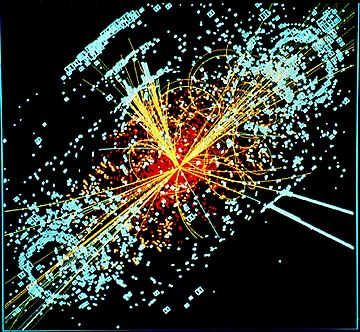
One possible signature of a Higgs boson from a simulated collision between two protons. It decays almost immediately into two jets of hadrons and two electrons, visible as lines.
Composition Elementary particle
Statistics Bosonic
Status A Higgs boson of mass ~ 125 GeV has been tentatively confirmed by CERN on 14 March 2013, although unclear as yet which model the particle best supports or whether multiple Higgs bosons exist.
Symbol H0
Theorised R. Brout, F. Englert, P. Higgs, G. S. Guralnik, C. R. Hagen, and T. W. B. Kibble (1964)
Discovered Previously unknown boson confirmed to exist on 4 July 2012, by the ATLAS and CMS teams at the Large Hadron Collider; tentatively confirmed as a Higgs boson of some kind on 14 March 2013 (see above).
Mass 125.3 ± 0.4 (stat) ± 0.5 (sys) GeV/c2, 126.0 ± 0.4 (stat) ± 0.4 (sys) GeV/c2
Mean lifetime 1.56×10⁻²² s (predicted in the Standard Model)
Decays into (observed) W and Z bosons, two photons. (Others still being studied)
Electric charge 0
Color charge 0
Spin 0 (tentatively confirmed at 125 GeV)
Parity +1 (tentatively confirmed at 125 GeV)
The Higgs boson or Higgs particle is an elementary particle initially theorized in 1964, and tentatively confirmed to exist on 14 March 2013. The discovery has been called "monumental" because it appears to confirm the existence of the Higgs field, which is pivotal to the Standard Model and other theories within particle physics. In this discipline, it explains why some fundamental particles have mass when the symmetries controlling their interactions should require them to be mass-less, and—linked to this—why the weak force has a much shorter range than the electromagnetic force. Its existence and knowledge of its exact properties are expected to impact scientific knowledge across a range of fields and should allow physicists to finally validate the last untested area of the Standard Model's approach to fundamental particles and forces, guide other theories and discoveries in particle physics, and—as with other fundamental discoveries of the past—potentially over time lead to developments in "new" physics, and new technologies.
This unanswered question in fundamental physics is of such importance that it led to a search of over 40 years for the Higgs boson and finally the construction of one of the most expensive and complex experimental facilities to date, the Large Hadron Collider, able to create and study Higgs bosons and related questions. On 4 July 2012, a previously unknown particle with a mass between 125 and 127 GeV/c2 was announced as being detected, which physicists suspected at the time to be the Higgs boson. By March 2013, the particle had been proven to behave, interact and decay in many of the expected ways predicted by the Standard Model, and was also tentatively confirmed to have + parity and zero spin, two fundamental criteria of a Higgs boson, making it also the first known scalar particle to be discovered in nature, although a number of other properties were not fully proven and some partial results do not yet precisely match those expected; in some cases data is also still awaited or being analyzed. As of March 2013 it is still uncertain whether its properties (when eventually known) will exactly match the predictions of the Standard Model, or whether additional Higgs bosons exist as predicted by some theories.

Aliens will find Earth absolutely amazingly beautiful and fragile to behold. But if they get close enough, they'll see 7,000,000,000 of us and think "Uh oh, that's a lot for such a small planet. Wonder if we should help?"
-
neufer

- Vacationer at Tralfamadore
- Posts: 18805
- Joined: Mon Jan 21, 2008 1:57 pm
- Location: Alexandria, Virginia
Scalar bosons
http://en.wikipedia.org/wiki/Inflaton wrote:<<The inflaton is a hypothetical scalar field (and its associated particle) that may be responsible for the hypothetical inflation in the very early universe. According to inflation theory, the inflaton field provided the mechanism to drive a period of rapid expansion from 10−35 to 10−34 seconds after the initial expansion that formed the universe. "Inflaton" conforms to the convention for field names, and joins such terms as photon and gluon.Click to play embedded YouTube video.
Boson means that it has an integer-valued spin. A scalar boson is a boson whose spin equals zero. Various known composite particles are scalar bosons, e.g. the alpha particle and the pi meson. Among the scalar mesons, one distinguishes between the scalar and pseudoscalar mesons, which refers to their transformation property under parity.
The only fundamental scalar boson in the standard model of elementary particle physics is the Higgs boson. There are various other hypothetical fundamental scalar bosons, including the inflaton. The inflaton field's lowest energy state may or may not be a zero energy state. This depends on the chosen potential energy density of the field. Prior to the expansion period, the inflaton field was at a higher-energy state. Random quantum fluctuations triggered a phase transition whereby the inflaton field released its potential energy as matter and radiation as it settled to its lowest-energy state. This action generated a repulsive force that drove the portion of the universe that is observable to us today to expand from approximately 10−50 metres in radius at 10−35 seconds to almost 1 metre in radius at 10−34 seconds.>>
Art Neuendorffer