
It's clear so far in Malmö, but the Sun won't rise for a few hours yet. I'm going to take a taxi to the observatory in Oxie, where all the necessary Sun-spotting equipment will be necessary.
I'm going to have exactly hone hour's sleep this night, because I've just returned home from a bat safari in Pildammsparken, the park right across the street from where I live! We were out for two and a half hours looking at and listening for various bats, and we heard and saw a lot of them, too. And now I'll be Venus-spotting soon.
It's crazy, but it's worth it!
Ann
APOD: Live: Watching for Venus to Cross... (2012 Jun 05)
Re: APOD: Live: Watching for Venus to Cross... (2012 Jun 05)
Color Commentator
-
iamlucky13

- Commander
- Posts: 515
- Joined: Thu May 25, 2006 7:28 pm
- Location: Seattle, WA
Re: APOD: Live: Watching for Venus to Cross... (2012 Jun 05)
It's raining in the Pacific NW, just like during the solar eclipse last month. 
So the semi-live feed from SDO makes a great APOD for my area.
However, did anyone notice the apparent corporate sabotage of Venus?
So the semi-live feed from SDO makes a great APOD for my area.
However, did anyone notice the apparent corporate sabotage of Venus?
- Attachments
-
"Any man whose errors take ten years to correct is quite a man." ~J. Robert Oppenheimer (speaking about Albert Einstein)
-
iamlucky13
- Commander
- Posts: 515
- Joined: Thu May 25, 2006 7:28 pm
- Location: Seattle, WA
Re: APOD: Live: Watching for Venus to Cross... (2012 Jun 05)
I believe you will be able get all the images after the transit is over from the SDO mission website, and I expect the project team will release their own movie of the transit.Zonthar wrote:is anyone else saving all the images to make a gif?
In fact, I just looked, and they have a live updating replay of the transit. As of the time of this post, it's 183 frames, playing as a loop running about 10 seconds:
http://venustransit.gsfc.nasa.gov/data/ ... se/ingress
More versions:
http://venustransit.gsfc.nasa.gov/
"Any man whose errors take ten years to correct is quite a man." ~J. Robert Oppenheimer (speaking about Albert Einstein)

Re: APOD: Live: Watching for Venus to Cross... (2012 Jun 05)
Weeping in Maryland. Darn big stupid cloud.
A closed mouth gathers no foot.
-
Indigo_Sunrise

- Science Officer
- Posts: 439
- Joined: Fri Jul 15, 2005 1:40 pm
- Location: Md
Re: APOD: Live: Watching for Venus to Cross... (2012 Jun 05)
owlice wrote:Weeping in Maryland. Darn big stupid cloud.
Did you get to see any of it, owlice?
I'm in So Md, and got about an hour's worth of viewing before the clouds moved in.
*fingerscrossedforyou*
Forget the box, just get outside.
Re: APOD: Live: Watching for Venus to Cross... (2012 Jun 05)
Indigo, I'm very envious of your hour of viewing! Thank you for the crossedfingers; much appreciated. Fruitless, but much appreciated! I should have gone to Arizona! New Mexico! Southern Maryland! Even Bowie MD would have been better, as the clouds there did part -- after a friend who lives there and I left Goddard -- and she saw the whole disk of the sun. I had seconds of viewing, widely spaced, of very small pieces of the sun. I never got the full solar disk. Not even half the disk. Not even a quarter or eighth of it! I might have seen Venus, but it might have been part of the big stupid cloud; tough to tell without more of the disk and/or more time.
Darn that big stupid cloud!
Darn that big stupid cloud!
A closed mouth gathers no foot.
-
antho87
Re: Gallery: Venus Transit 2012
Poor viewing here  in eastern Ct. overcast sky's, although the clouds did part for about a 1 to 2 second glimpse of Venus just as it fully crossed the solar limb. unfortunately I was not fast enough to snap a photo
in eastern Ct. overcast sky's, although the clouds did part for about a 1 to 2 second glimpse of Venus just as it fully crossed the solar limb. unfortunately I was not fast enough to snap a photoRe: APOD: Live: Watching for Venus to Cross... (2012 Jun 05)
Taken just at sunset in Dominica, West Indies.
http://a3.sphotos.ak.fbcdn.net/hphotos- ... 2739_n.jpg
http://a3.sphotos.ak.fbcdn.net/hphotos- ... 2739_n.jpg
Re: APOD: Live: Watching for Venus to Cross... (2012 Jun 05)
The sun is down here, but APOD is up. It's almost like being there (every 15 minutes). 
Thank you.
Thank you.
Re: APOD: Live: Watching for Venus to Cross... (2012 Jun 05)
Whoa, lizzie. Nice!lizziemad wrote:Taken just at sunset in Dominica, West Indies.
http://a3.sphotos.ak.fbcdn.net/hphotos- ... 2739_n.jpg
-
ken a
Re: APOD: Live: Watching for Venus to Cross... (2012 Jun 05)
the live satellite feed of the venus transit was the coolest thing i have ever seen and i have been into astronomy for over forty years
-
darkmatter
Re: APOD: Live: Watching for Venus to Cross... (2012 Jun 05)
Saw this on screen through telescope today, only due to finger incident at work and having to finish early... 
-
neufer

- Vacationer at Tralfamadore
- Posts: 18805
- Joined: Mon Jan 21, 2008 1:57 pm
- Location: Alexandria, Virginia
Re: APOD: Live: Watching for Venus to Cross... (2012 Jun 05)
owlice wrote:
Weeping in Maryland. Darn big stupid cloud.
- More bad news:

Art Neuendorffer

Re: APOD: Live: Watching for Venus to Cross... (2012 Jun 05)
Don't worry Neufer, in 2117 there will be fast ways to transport you whereever you want to be...and if you follow the 7 Longevity factors discussed in the forum, you will seeneufer wrote:owlice wrote:
Weeping in Maryland. Darn big stupid cloud.
- More bad news:
that transit with your own eyes, if not I suggested you to send me your hair, I will clone you


-
Sinan İpek
Re: APOD: Live: Watching for Venus to Cross... (2012 Jun 05)
Here is my questions:
1. What opportunities did Venus cross present to astronomers? I think it is a good chance to observe Venus' atmposphere and to measure the distances of the Sun and Venus. What other possibilites?
2. What was the science behind measuring the distance of the Sun from Earth by observing Venus Cross 117 years ago? How a scientist did use trigonometry without knowing exact dimensions of the Sun and Venus?
3. We know that Venus is about the size of Earth. Can we take this photos as an exact size comparison of Earth to the Sun?
Thanks for the answers.
1. What opportunities did Venus cross present to astronomers? I think it is a good chance to observe Venus' atmposphere and to measure the distances of the Sun and Venus. What other possibilites?
2. What was the science behind measuring the distance of the Sun from Earth by observing Venus Cross 117 years ago? How a scientist did use trigonometry without knowing exact dimensions of the Sun and Venus?
3. We know that Venus is about the size of Earth. Can we take this photos as an exact size comparison of Earth to the Sun?
Thanks for the answers.
-
DavidLeodis

- Perceptatron
- Posts: 1169
- Joined: Mon May 01, 2006 1:00 pm
Re: APOD: Live: Watching for Venus to Cross... (2012 Jun 05)
Does anyone know of a link that will bring up a movie of the full transit but showing the full disc of the Sun (as in the APOD), as all the links I can find only show the transit across a segment of the Sun's disc? A record of the transit would be even more impressive to watch if there is a movie available that had the same filter as in the APOD, so showing sunspots as well as the transit. Thanks for any help.

Re: APOD: Live: Watching for Venus to Cross... (2012 Jun 05)
DavidLeodis wrote:Does anyone know of a link that will bring up a movie of the full transit but showing the full disc of the Sun (as in the APOD), as all the links I can find only show the transit across a segment of the Sun's disc? A record of the transit would be even more impressive to watch if there is a movie available that had the same filter as in the APOD, so showing sunspots as well as the transit. Thanks for any help.
Click to play embedded YouTube video.
Know the quiet place within your heart and touch the rainbow of possibility; be
alive to the gentle breeze of communication, and please stop being such a jerk. — Garrison Keillor
alive to the gentle breeze of communication, and please stop being such a jerk. — Garrison Keillor
-
DavidLeodis
- Perceptatron
- Posts: 1169
- Joined: Mon May 01, 2006 1:00 pm
Re: APOD: Live: Watching for Venus to Cross... (2012 Jun 05)
Thank you bystander and tasosne. Your help is appreciated. 
-
neufer
- Vacationer at Tralfamadore
- Posts: 18805
- Joined: Mon Jan 21, 2008 1:57 pm
- Location: Alexandria, Virginia
Re: APOD: Live: Watching for Venus to Cross... (2012 Jun 05)
Moonlady wrote:
[Neufer, ...] if you follow the 7 Longevity factors discussed in the forum, you will see
[the 2117] transit with your own eyes, if not I suggested you to send me your hair,
I will clone you
- More bad news for the Starship Asterisk*
Art Neuendorffer
-
neufer
- Vacationer at Tralfamadore
- Posts: 18805
- Joined: Mon Jan 21, 2008 1:57 pm
- Location: Alexandria, Virginia
Re: APOD: Live: Watching for Venus to Cross... (2012 Jun 05)
They accurately knew the relative sizes of the sun, the (other) planets and their orbits (vis-a-vis the Earth's orbit); but they had no absolute scale for anything outside of the size of the Earth itself.Sinan İpek wrote:
2. What was the science behind measuring the distance of the Sun from Earth by observing Venus Cross 117 years ago?
How a scientist did use trigonometry without knowing exact dimensions of the Sun and Venus?
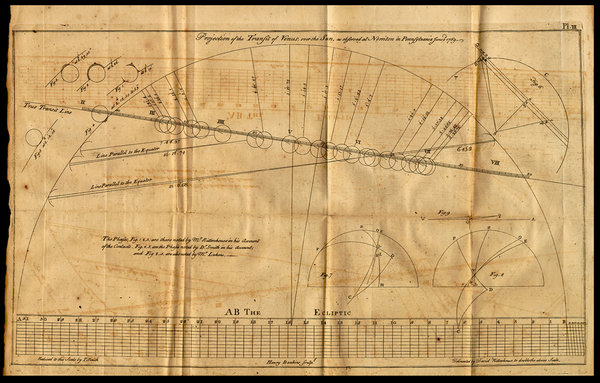

So the object was to measure the absolute size of the sun by measuring the size of Venus's circular shadowed region (i.e., penumbra) vis-a-vis the size of the Earth itself.
Since Venus is ~2/3's the distance to the Earth the size of Venus's penumbra is only about half the size of the Sun. The size of the Earth is not negligibly small in relationship to this penumbra such that by accurately measuring the duration of the transit from different latitudes the size of this penumbra can be deduced. Once the size of the penumbra is determined one knows the size of the Sun and therefore everything else in the solar system.
Since Venus is ~2/3's the distance to the EarthSinan İpek wrote:
3. We know that Venus is about the size of Earth.
Can we take this photos as an exact size comparison of Earth to the Sun?
Venus appears to be ~3 times larger relative to the Sun than one might expect otherwise.
Art Neuendorffer
-
neptunium
Re: APOD: Live: Watching for Venus to Cross... (2012 Jun 05)
I think the current image should be replaced by a time-lapse video of the transit.
Re: APOD: Live: Watching for Venus to Cross... (2012 Jun 05)
From what I have read, this "transparency" may be a result of detector persistence; because the AIA detectors were continually awash in light from the sun, the detectors retained the previous image (similar, I think, to the old "ghosting" one might have seen on an old television immediately after it was turned off, or burn-in on an old computer monitor) of the surface of the sun as Venus eclipsed the disk. Detectors are refreshed when looking at blank sky or dark areas. It may be that some detectors are more sensitive or prone to this persistence, which may account for this showing up more in some tracks than in others.Ubimo wrote:Why are there dark rings on the dark side of Venus? You can see them in the videos here http://venustransit.gsfc.nasa.gov/
Here is the particular movie http://venustransit.gsfc.nasa.gov/data/ ... se/ingress
Edit:
And Venus seems to be transparent. You can see the edge of the sun through Venus.
If anyone has another explanation for this, please share; thanks!
A closed mouth gathers no foot.
-
Chris Peterson

- Abominable Snowman
- Posts: 18185
- Joined: Wed Jan 31, 2007 11:13 pm
- Location: Guffey, Colorado, USA
- Contact:
Re: APOD: Live: Watching for Venus to Cross... (2012 Jun 05)
What you are talking about is called residual bulk image, and it occurs in CCD detectors because some electrons (which are produced when photons are captured) are trapped in the bulk structure of the silicon, below the actual pixel layer. It can be a challenge to deal with in some cases. It's certainly an issue with almost all the cameras used professionally, both on the ground and in space. It is certainly a likely candidate for this ghosting.owlice wrote:From what I have read, this "transparency" may be a result of detector persistence; because the AIA detectors were continually awash in light from the sun, the detectors retained the previous image (similar, I think, to the old "ghosting" one might have seen on an old television immediately after it was turned off, or burn-in on an old computer monitor) of the surface of the sun as Venus eclipsed the disk. Detectors are refreshed when looking at blank sky or dark areas. It may be that some detectors are more sensitive or prone to this persistence, which may account for this showing up more in some tracks than in others.
I've seen some comments from the camera operators that this effect might be caused by some sort of readout crosstalk between the different camera channels. The image is apparently placed simultaneously on four different detector quadrants, through different filters.If anyone has another explanation for this, please share; thanks!
Last edited by Chris Peterson on Sun Jun 10, 2012 4:40 pm, edited 1 time in total.
Chris
*****************************************
Chris L Peterson
Cloudbait Observatory
https://www.cloudbait.com
*****************************************
Chris L Peterson
Cloudbait Observatory
https://www.cloudbait.com
Re: APOD: Live: Watching for Venus to Cross... (2012 Jun 05)
Chris, thanks very much!
A closed mouth gathers no foot.