APOD: Our Story in One Minute (2012 Nov 14)
-
Guest
Re: APOD: Our Story in One Minute (2012 Nov 14)
Great clip! The mountains in the video are pretty young and rugged. My guess is Mount Cook in the Southern Alps of New Zealand.
-
superdave2012
Re: APOD: Our Story in One Minute (2012 Nov 14)
That was pretty neat, but a bit short indeed! By the way, the universe was created for our and God's enjoyment. After all, we have an awesome God and it is NOT arrogant to think that we are the only race of beings--actually there are other created beings----the devil's fallen angels and the unfallen ones in heaven with God.

Re: APOD: Our Story in One Minute (2012 Nov 14)
Here is the view from the top of the Burj Khalifa
not for the faint of heart
not for the faint of heart
Click to play embedded YouTube video.
-
jimmycrackcorn90745
- Asternaut
- Posts: 5
- Joined: Wed Sep 14, 2005 6:58 am
- Location: carson,ca
Re: APOD: Our Story in One Minute (2012 Nov 14)
Now, if we can only have a 1 min video of our future 
-
BDanielMayfield
- Don't bring me down
- Posts: 2524
- Joined: Thu Aug 02, 2012 11:24 am
- AKA: Bruce
- Location: East Idaho
Re: APOD: Our Story in One Minute (2012 Nov 14)
No need to be apologetic for being Christian Carole. I too am a believer, but I also see no reason why the “beginning” of Genesis 1:1 couldn’t have spanned even billions of years. Since God is described as being without a beginning, his universal creations could have begun 14 or so billion years ago with no problem from a Scriptural standpoint. To me the BBT is a plausible way in which the Universe may have come into existence, born from the energy that the Almighty provided operating according the rules (the laws of physics) that the Creator ordained.Carole wrote:Sorry, guys. I'm a Christian, and I do not believe in the big bang theory. God created the heavens and the earth by speaking them into existence. No, it doesn't make logical sense. Yes, it takes faith to believe it. And I believe it. Just wanted you to know that you don't speak for me. It's not my story at all.
Anthony, I don’t see myself as a fundamentalist, although you might it would seem. I do view the Bible as inspired, but I’ve learned that much of it is figurative and symbolic. Problems with the Bible arise when people take parts of it too literally, such as believing that the creative days of Geneses chapter one are literal 24 hr days. The basic order of events as recounted in the creation account can be harmonized with the known facts about the Earth’s geologic record. You over-generalize with your last statement however, since nether of us have attempted to silence the other. (I hope)Anthony Barreiro wrote:I find fundamentalism equally unsatisfactory and frustrating regardless of the sacred text chosen as the foundation of belief, whether it be an ancient religious book or current scientific theory. The best religious perspectives have the advantage of taking mystery seriously and thus cultivating humility. The scientific method has the advantage of testing beliefs against observations and thus developing better models of reality. But we all crave greater certainty than the world provides, so we cling to our familiar and comfortable beliefs and attempt to silence those whose experience and beliefs are different than our own.
Steve62’s expression fits my own thinking well, except that I wouldn’t be quite as critical of this video. Except for the percentage of time given to primates, this video wouldn’t be all that evolutionary. BMAONE23’s response is well taken too though, but I wouldn’t say that belief in creation is belief in something from nothing, although belief in the BBT without a Creator involved would be. To me the idea that everything in this magnificent Universe came about accidentally is illogical. If there ever was a time when there was absolutely nothing then there would always be absolutely nothing. The fact that we and the Universe are here proves to me that something must have always been in existence. The presence of orderly laws implies the existence of a lawgiver.BMAONE23 wrote:It would seem to me that Belief in Big Bang and Belief in Biblical creation are basically the same thing, the belief in something from nothing. One ascribes it to a Supreme Being describing the possible order of occurances and the other describes the method that possible Supreme Being used to bring things together during the period of creation/big bangSteve62 wrote:Complete Science Fiction. In the beginning God created the Heavens and the Earth.
The Religion of Evolution requires belief in chance and time and life coming from nothing. Great faith, not science.
I do love seeing the photos of God's creation though in APOD.
Bruce
Just as zero is not equal to infinity, everything coming from nothing is illogical.

Re: APOD: Our Story in One Minute (2012 Nov 14)
[administrator hat]
If you must discuss religion here, do it in PM; do NOT engage in discussion about religion on the board. Frankly there are many other more fitting places for such discussion; this is not the place for it.
In other words, read and follow the rules you agreed to by posting here.
Thank you.
Owlice
[/administrator hat]
If you must discuss religion here, do it in PM; do NOT engage in discussion about religion on the board. Frankly there are many other more fitting places for such discussion; this is not the place for it.
In other words, read and follow the rules you agreed to by posting here.
Thank you.
Owlice
[/administrator hat]
A closed mouth gathers no foot.
-
leoneri
Re: APOD: Our Story in One Minute (2012 Nov 14)
looks like Darth Vader to me.. but what the heck is he doing there? trying to connect to the force?Beyond wrote: Say... wasn't that a Yeti standing on the mountain top at the endIt looked just a little too big to be a human.

-
neufer

- Vacationer at Tralfamadore
- Posts: 18805
- Joined: Mon Jan 21, 2008 1:57 pm
- Location: Alexandria, Virginia
Re: APOD: Our Story in One Minute (2012 Nov 14)
<<George Herbert Leigh Mallory (18 June 1886 – 8 or 9 June 1924) is famously quoted as having repliedleoneri wrote:looks like Darth Vader to me.. but what the heck is he doing there? trying to connect to the force?Beyond wrote:
Say... wasn't that a Yeti standing on the mountain top at the end
to the question "Why do you want to climb Mount Everest?" with the retort "Because it's there".>>
http://en.wikipedia.org/wiki/Mountaineering#History wrote:. Though it is unknown whether his intention was to reach a summit, "Ötzi the Iceman" ascended at least 3,000 metres in the Alps about 5,300 years ago. His remains were found at that altitude, preserved in a glacier.
- History of Mountaineering
. The first recorded mountain ascent in the Common Era is Roman Emperor Hadrian's ascent of Etna (3,350 m) to see the sun rise in 121.
. Peter III of Aragon climbed Canigou in the Pyrenees in the last quarter of the 13th century.
. The first ascent of the Popocatépetl (5,426 m in Mexico) was reported in 1289 by members of a local tribe.
. The Italian poet Petrarch wrote that on April 26, 1336 he, together with his brother and two servants, climbed to the top of Mont Ventoux (1,909 m).
. The Rocciamelone (3,538 m) in the Italian Alps was climbed in 1358.
. In the late 15th/early 16th centuries, ascents were made of numerous high peaks in the Andes, for religious purposes by citizens of the Inca Empire and their subjects. They constructed platforms, houses & altars on many summits and carried out sacrifices, including human sacrifices. The highest peak they are known for certain to have climbed is Llullaillaco (6,739 m). They may also have ascended the highest peak in the Andes, Aconcagua (6,962 m) as a sacrifice victim has been found at over 5,000 m on this peak.
. In 1492 the ascent of Mont Aiguille was made by order of Charles VIII of France. The Humanists of the 16th century adopted a new attitude towards mountains, but the disturbed state of Europe nipped in the bud the nascent mountaineering of the Zurich school.
. Leonardo da Vinci climbed to a snow-field in the neighborhood of Monte Rosa and made scientific observations.
. In 1642 Darby Field made the first recorded ascent of Mount Washington, then known as Agiocochook, in New Hampshire.
. Richard Pococke and William Windham's historic visit to Chamonix was made in 1741, and set the trend for visiting glaciers.
. The first attempt to ascend Mont Blanc was made in 1775 by a party of natives. In 1786 Dr Michel-Gabriel Paccard and Jacques Balmat gained the summit for the first time. Horace-Bénédict de Saussure, the initiator of the first ascent followed next year.
. The Grossglockner was climbed in 1800, the Ortler in 1804, the Jungfrau in 1811, the Finsteraarhorn in 1812, and the Breithorn in 1813. Thereafter, tourists showed a tendency to climb, and the body of Alpine guides began to come into existence as a consequence.
. The British scientist, Sir John Herschel, makes an ascent in 1824 where on July 23 he carries out a barometric determination of the height of Mount Etna.
. Aconcagua (22,831 feet), the highest peak of the Andes was first climbed in 1897 and the Grand Teton (13,747 feet)in North America's Rocky Mountains was ascended in 1898.
. The Italian Duke of the Abruzzi in 1897 made the first ascent on Mount Saint Elias (18,009 feet) which stands at the boundary of Alaska and Canada and in 1906 successfully climbed Margherita in the Ruwenzori group (16,795 feet) in East Africa. In 1913, an American, Hudson Stuck ascended Mount McKinley (20,320 feet) in Alaska, the highest peak in North America.
. The Alpine Club was founded in London in 1857, and was soon imitated in most European countries. Edward Whymper's ascent of the Matterhorn in 1865 marked the close of the main period of Alpine conquest, the Golden age of alpinism, during which the craft of climbing was invented and "perfected", the body of professional guides formed and their traditions fixed.
. The Edelweiss Club Salzburg was founded in Salzburg in 1881, and had 3 members make the first ascent on two Eight-thousanders, Broad Peak (1957) and Dhaulagiri (1960).>>

Art Neuendorffer
-
nateman
Re: APOD: Our Story in One Minute (2012 Nov 14)
The Skyscraper is the Burj Khalifa in Dubai, currently the worlds tallest. Why not brag about our story? How much of that hydrogen out there organizes with it's fellow elements and creates itself into a form where the universe can be aware of itself? Life is special, a way for information to replicate and diversify. Among these self replicating units of information called life the Earth's master of information itself is MAN. That makes MAN the most special thing we know of in the Universe so far. If there is any other master of information that does it better than MAN it will probably find us first if it has not done so already.
-
neufer
- Vacationer at Tralfamadore
- Posts: 18805
- Joined: Mon Jan 21, 2008 1:57 pm
- Location: Alexandria, Virginia
Re: APOD: Our Story in One Minute (2012 Nov 14)
nateman wrote:
Among these self replicating units of information called life the Earth's master of information itself is MAN. That makes MAN the most special thing we know of in the Universe so far. If there is any other master of information that does it better than MAN it will probably find us first if it has not done so already.
- WOMAN
Art Neuendorffer

Re: APOD: Our Story in One Minute (2012 Nov 14)
The turtles remind me of a performance I saw last weekend. Three performers completely dressed in black, with every bit of skin covered in black make-up, entered a dimly lit stage wrapped in black drapery. They brought a turtle, a keyboard and a wood stove. They put the turtle on the keyboard, where it played a strange tune. They made a fire in the wood stove and danced around with sparklers, and they juggled a luminous, orange-yellow sphere. Suddenly, there was a brilliant light, and...Crass Novice wrote:I liked today's APOD except for the fact that Ms. Sheep forgot about the turtles.
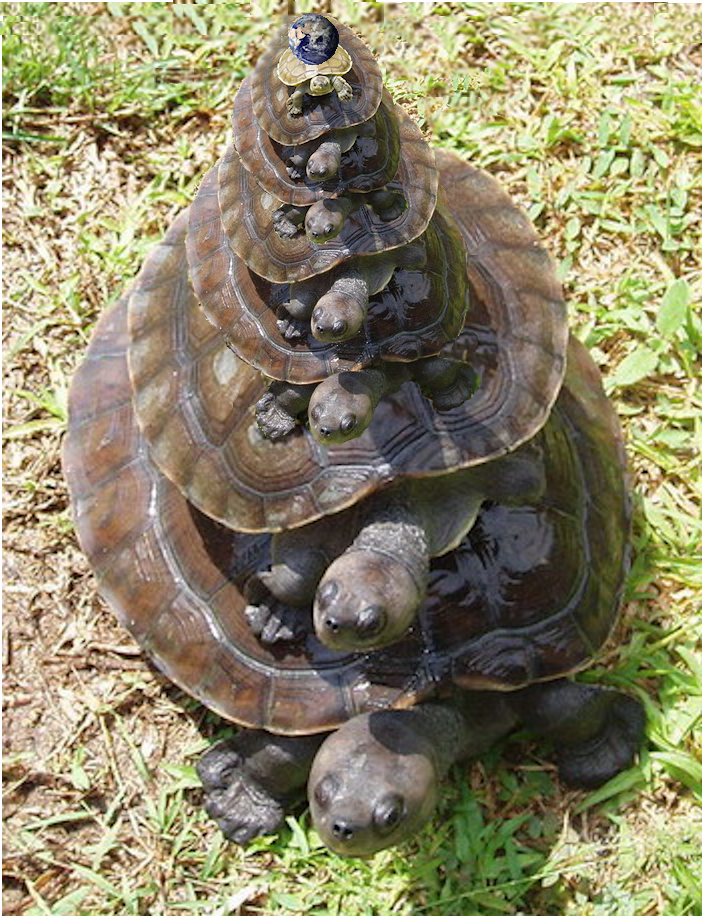
Well, after that things went on and showed us the performers' personal take on the history of the universe and humanity! I rather liked it.
But today's APOD is also nice.
Ann
Color Commentator

Re: APOD: Our Story in One Minute (2012 Nov 14)
Hmm... all the turtles heads are looking to the right, except for the little one holding the earth. He looks like he is about to step forward and take the earth somewhere. 'That', could cause quite a commotion! Stay tuned. News at 11:00(?), IF the 'Humpty-Dumpty' factor doesn't kick-in. Other-wise, it'll be Breaking *Broken* news.
To find the Truth, you must go Beyond.
Re: APOD: Our Story in One Minute (2012 Nov 14)
I believe . . . . . . .’tis time for a pint.
Re: APOD: Our Story in One Minute (2012 Nov 14)
At the beginning of the series "Wonders of the Universe" that frames with this mountain and man....Prof. Brian Cox
-
SuperBoppy1
Re: APOD: Our Story in One Minute (2012 Nov 14)
This video is pure fantasy, and doesn't explain one thing about the beginning of the Universe, or the origin of life. It just assumes with a "wink-wink, nod-nod" that everyone is on the same page as they watch this "whatever-it-is-supposed-to-prove" thing. I like the music, though.
-
steveboy
Re: APOD: Our Story in One Minute (2012 Nov 14)
The building is the Burg Khalifa in Dubai at over 800 metres (yes Boys and Girls that is metres) ...the Engineers had to rethink how to make concrete for the supporting pillons in the ground (as there is no bedrock!!).
The mountain well i really don't know but have a guess its somewhere in Switzerland, New Zealand (topical) or Tibet??

The mountain well i really don't know but have a guess its somewhere in Switzerland, New Zealand (topical) or Tibet??