http://www.universetoday.com/95054/earth-has-less-water-than-you-think/#more-95054 wrote:Earth Has Less Water Than You Think
by Jason Major, Universe Today, May 8, 2012
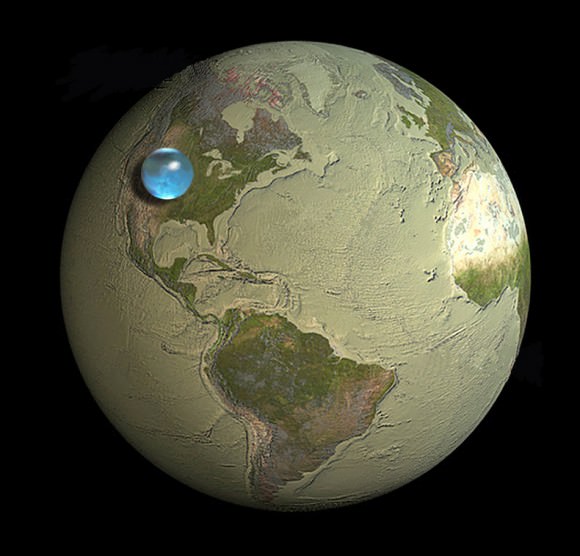
<<If you were to take all of the water on Earth — all of the fresh water, sea water, ground water, water vapor and water inside our bodies — take all of it and somehow collect it into a single, giant sphere of liquid, how big do you think it would be? According to the U. S. Geological Survey, it would make a ball 860 miles (1,385 km) in diameter, about as wide edge-to-edge as the distance between Salt Lake City to Topeka, Kansas. That’s it. Take all the water on Earth and you’d have a blue sphere less than a third the size of the Moon.
And this takes into consideration all the Earth’s water… even the stuff humans can’t drink or directly access, like salt water, water vapor in the atmosphere and the water locked up in the ice caps. In fact, if you were to take into consideration only the fresh water on Earth (which is 2.5% of the total) you’d get a much smaller sphere… less than 100 miles across.
Even though we think of reservoirs, lakes and rivers when we picture Earth’s fresh water supply, in reality most of it is beneath the surface — up to 2 million cubic miles of Earth’s available fresh water is underground. But the vast majority of it — over 7 million cubic miles is in the ice sheets that cover Antarctica and Greenland.
Of course, the illustration above (made by Jack Cook at the Woods Hole Oceanographic Institution) belies the real size and mass of such a sphere of pure liquid water. The total amount of water contained within would still be quite impressive — over 332.5 million cubic miles (about 4 Sagan teaspoons of water)! Still, people tend to be surprised at the size of such a hypothetical sphere compared with our planet as a whole, especially when they’ve become used to the description of Earth as a “watery world”.
- Water, water, every where,
And all the boards did shrink;
Water, water, every where,
Nor any drop to drink.
– from The Rime of the Ancient Mariner, Samuel Taylor Coleridge>>
Nor any drop to drink.
-
neufer

- Vacationer at Tralfamadore
- Posts: 18805
- Joined: Mon Jan 21, 2008 1:57 pm
- Location: Alexandria, Virginia
Nor any drop to drink.

Art Neuendorffer

Re: Nor any drop to drink.
Indeed, the Earth has much less water than the average person probably believes, given the fact that the Earth is sometimes referred to as a "water world". Also, we are often being told that other celestial bodies (such as the Moon and Venus) are uninhabitable partly because they lack water.
So the Earth doesn't have much water, comparatively speaking, but we have it where it counts - on the interface of things. Water is "the skin of the world", sitting right between our protective atmosphere and the still roiling and active interior of our planet's crust. The water of the Earth is continually fed energy and substances from above and below. It is an incredibly dynamic substance here on our planet, given all the input it continually receives.
And interestingly, the most "alive" parts of the water of the Earth are the shallow parts where water meets land. Here is where you find the most activity and the greatest number of biological species, as well as - or so I think - the greatest biomass.
Indeed, water as an interface between active layers above and below may be the key to biological life. A ball of ice floating in space may be rich in H2O indeed, but it may be completely dead.
Or not.
Ann
So the Earth doesn't have much water, comparatively speaking, but we have it where it counts - on the interface of things. Water is "the skin of the world", sitting right between our protective atmosphere and the still roiling and active interior of our planet's crust. The water of the Earth is continually fed energy and substances from above and below. It is an incredibly dynamic substance here on our planet, given all the input it continually receives.
And interestingly, the most "alive" parts of the water of the Earth are the shallow parts where water meets land. Here is where you find the most activity and the greatest number of biological species, as well as - or so I think - the greatest biomass.
Indeed, water as an interface between active layers above and below may be the key to biological life. A ball of ice floating in space may be rich in H2O indeed, but it may be completely dead.
Or not.
Ann
Color Commentator
-
neufer
- Vacationer at Tralfamadore
- Posts: 18805
- Joined: Mon Jan 21, 2008 1:57 pm
- Location: Alexandria, Virginia
The rain in Acidalia stayed mainly on the Planitia

Universe Today by Jason Major on May 8, 2012
.http://www.universetoday.com/95068/more-evidence-of-mars-watery-past/ wrote:
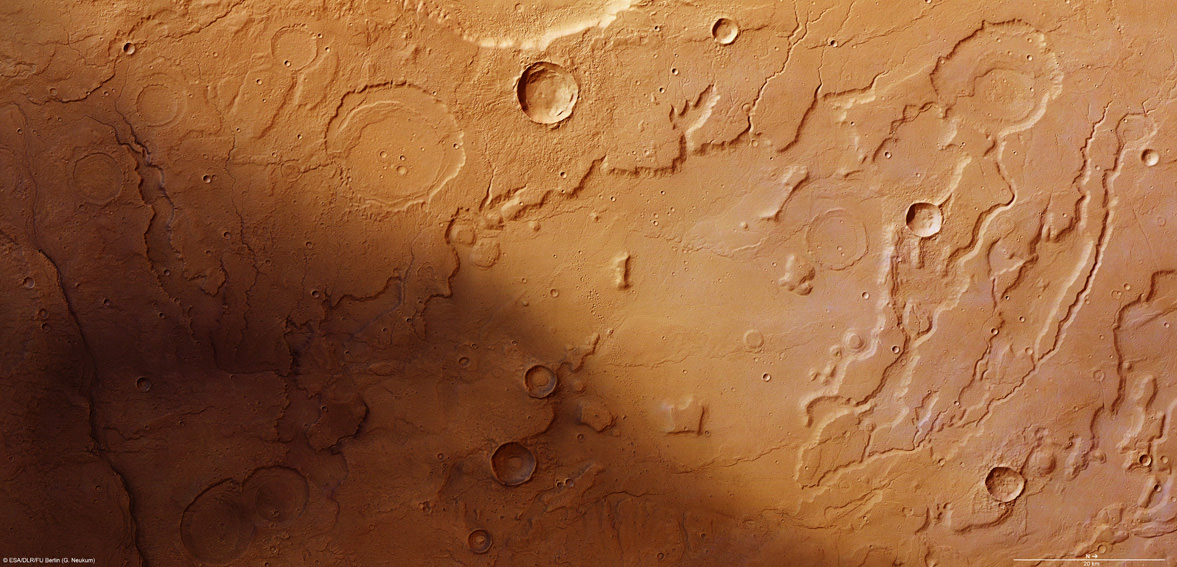
<<ESA’s Mars Express orbiter has sent back images revealing terrain that seems to have been sculpted by flowing water, lending further support to the hypothesis that Mars had liquid water on its surface at some point. The region seen in a HRSC image is along the border of the Acidalia Planitia region, a vast, dark swath of Mars’ northern hemisphere so large that it’s visible from Earth. In the HRSC image some of the etched valleys extend outwards from craters, implying that they were created by water emptying out from within the craters. In addition, sediments present within older craters indicate that they were once filled with water, likely for an extended time.
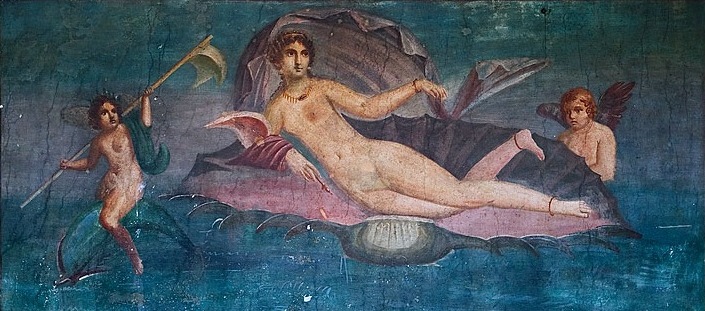
In 1877 the Italian astronomer Giovanni Schiaparelli named the [Acidalia] region after a mythical fountain, where the three Graces of Greek mythology were said to have bathed. Although there may not be any fountains or ancient Immortals within Acidalia Planitia, there may have been water — enough to carve serpentine channels and steep scallops along the edges of wide valleys, much in the same way that the Grand Canyon was carved by the Colorado River.>>
http://en.wikipedia.org/wiki/Acidalia_Planitia wrote:
<<Acidalia Planitia is a plain on Mars. It is located between the Tharsis volcanic province and Arabia Terra to the north of Valles Marineris, centered at 46.7°N 338.0°E. The plain contains the famous Cydonia region at the contact with the heavily cratered highland terrain.
The plain is named after a corresponding albedo feature on a map by Giovanni Schiaparelli, which was in turn named after the mythological fountain of Acidalia.
It has been hypothesized by J.E.Brandenburg from Orbital Technologies Corp. that a large natural nuclear reactor in the northern Mare Acidalium, near the large, shallow depression north of Acidalia Colles (similar to Oklo on Earth) underwent catastrophic meltdown.>>
Signs of ancient flowing water on Mars
ESA Space Science | 2012 May 04
Art Neuendorffer